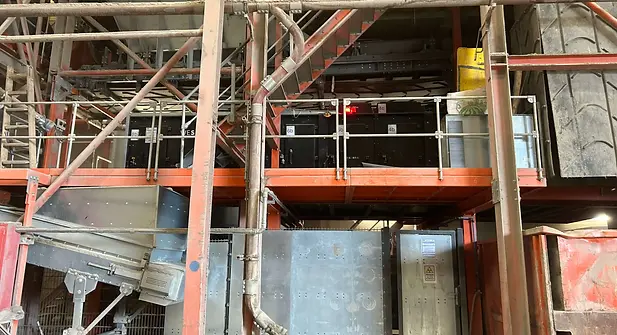
When consumer junk brings operations to a standstill.
Residual and bulky waste is becoming increasingly unpredictable for waste processors. There is a strong desire for waste to be sorted as thoroughly as possible – yet at the same time, more and more hazardous electronic waste is ending up in the black bin. If these foreign objects make their way undetected into the complex machinery, the result is costly damage.
Unidentified arsonists: Individual batteries and battery-powered devices enter the system unnoticed and catch fire immediately under mechanical pressure.
Costly machine damage: Cast-iron pots, car parts or thick tangles of cable in the secondary shredder can cause damage to the blades and result in hours of downtime.
Pressure from insurers: High fire loads and mechanical risks associated with household waste result in extremely stringent fire safety requirements or the cancellation of the policy.
“General waste is becoming increasingly hazardous due to the widespread use of batteries and small electronic devices in everyday life. A single undetected battery in the shredder can ruin weeks’ worth of profit. Anyone wishing to recycle general waste streams profitably and safely today must remove hazardous substances before the material undergoes mechanical processing.”
Johannes Laier, co-founder and co-CEO at WeSort.AI



Energy sources (fire risk)
-
Lithium-ion batteries and battery packs
-
Electronic waste (e.g. faulty tools, toys, mobile phones)
-
Hidden button cells and battery cells in household waste
A peek inside the grey sack thanks to X.Sort: detection despite dirt and bags
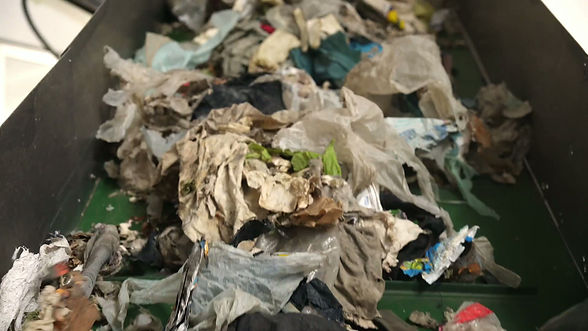
Once the containers have been opened or the material has undergone initial shredding, the reality becomes clear: a heavy, opaque mix of household waste, some of which is still wrapped.
Purely optical camera systems cannot see anything at all here. They are hampered by dust, moisture or thick layers. X.Sort therefore uses multi-energy X-ray (XRT): the system scans the entire stream and generates a precise black-and-white image of the material density. On this basis, the AI analyses the geometric contours of the objects. This allows hazardous materials to be identified purely on the basis of their shape.

X.Sort: Full throughput from the very first minute
Commercial waste sorting relies on throughput. Contaminant detection must never become a bottleneck. X.Sort is designed specifically for these demanding high-volume flows and safeguards your entire sorting plant right at the start of the process.
Technical specifications for commercial use
Parameter | Spezifikation |
|---|---|
Throughput | At least 60 t/h |
Layer density | Up to 25 cm |
Recognition technology | Multi-energy X-ray (XRT) combined with our AI. |
Conveyor belt speed | Up to 4.0 m/s – full performance for the mass flow. |
Case Study: 24/7 operations at Korn Recycling
At Korn Recycling’s bulky waste and commercial waste sorting facility, our technology ensures a material feed of around 100,000 tonnes per year. The early removal of contaminants immediately after input ensures safe plant operation every day, with a reduction of over 90 per cent in battery-related fires.