
■ Use Cases
Sorting out hazardous objects from e-waste
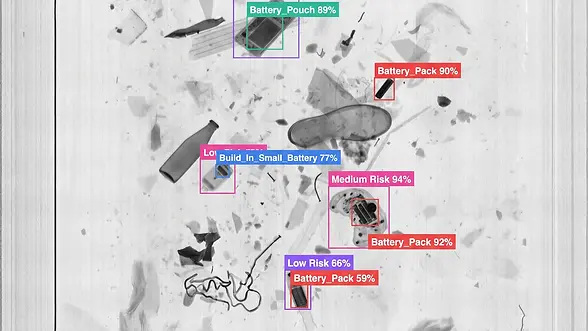
Hidden batteries and large pieces of foreign metal pose a daily risk to your electronic waste processing plant, potentially causing fires or damage to machinery. The compact X.Sort M uses X-rays to scan the material, whilst AI analyses the data in real time.
Hidden sources of fire and extreme wear and tear
Anyone processing end-of-life electronics faces a clear challenge: input material is growing more complex, while the most hazardous substances are hidden deep inside the casings — out of reach for any superficial inspection.
Hidden fire hazards: Lithium batteries in tools or tablets are invisible from the outside. When subjected to mechanical stress – for example, from shredding equipment – they ignite immediately and, in the worst-case scenario, can set the entire hall alight.
Large foreign objects: Heavy metal parts, thick bolts or stainless steel that pass through conventional magnetic separators immediately damage the blades in the secondary shredder. This results in costly breakdowns.
“Anyone who fails to remove batteries and large foreign objects from the production line in good time puts their machinery and their own workshop at risk on a daily basis. We protect machinery from fires and prevent tools from being written off – all within an extremely compact space.”
Johannes Laier, co-founder and co-CEO at WeSort.AI



Energy sources (fire risk)
Fixed lithium-ion batteries, loose battery packs and hidden button cells
X-ray vision instead of surface-mounted sensors
Conventional camera systems quickly reach their limits when it comes to electronic waste, as they only capture the outer casing of the devices. What lies inside a plastic or metal casing remains undetected.
The X.Sort M breaks through these physical limitations. The system uses X-ray technology: the sensors effortlessly penetrate the casings. Based on the X-ray images, our AI analyses the geometric contours in milliseconds. It identifies batteries and other contaminants based on their structure.

X.Sort M: Compact design, flexible, bespoke discharge system
Small material flows and confined spaces call for clever technology rather than huge machines. The X.Sort M operates as a compact, plug-and-play unit. It can be integrated directly into your existing line without the need for major modifications. Depending on your process flow, you can choose the most suitable method for safely removing the detected contaminants from the conveyor belt:
Technical specifications for the handling of electronic waste
Parameter | Spezifikation |
|---|---|
Format | Extremely compact footprint – perfect for small halls. |
Layer density | Up to 50 cm |
Recognition technology | Multi-energy X-ray (XRT) combined with our AI. |
Conveyor belt speed | At least 2 m/s – optimised for the precise analysis of waste electrical and electronic equipment. |